


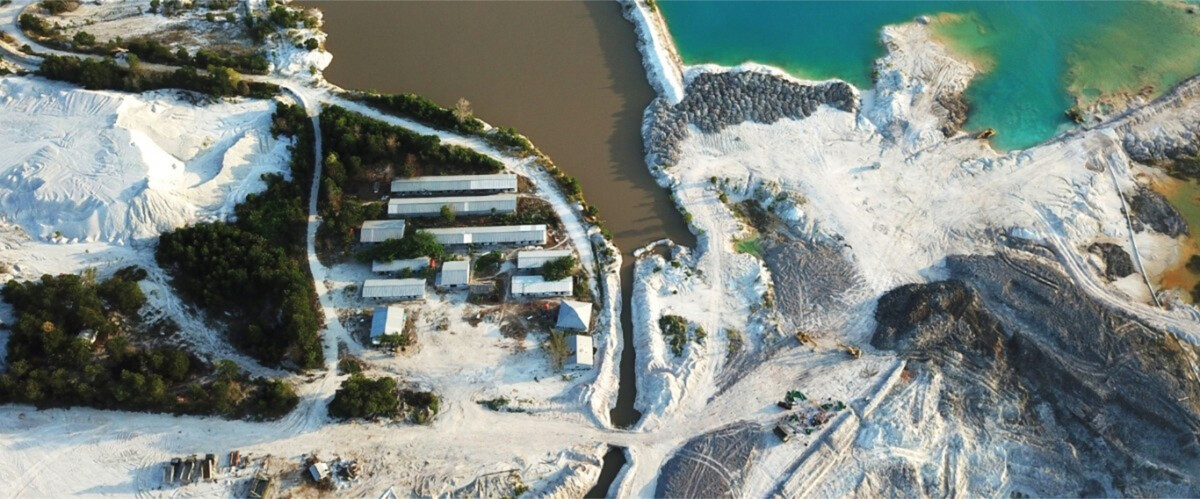
How We Do It
The process of mining and smelting of tin is relatively simpler than the process required of other minerals (gold, copper nickel, iron ore, etc) and the steps consist as follow:
- Removal of the overburden covering the tin ore and waste disposal at a proper designated site.
- Extract and transfer the ore to a field processing plant for removal of the impurities of the tin ore using one of two available methods (or both), as follow:
- Wet mining, where the ore is pushed into a slurry pit and then pumped directly to the field processing plant.
- Dry mining, where the ore is transferred using vehicles (trucks) to the processing plant.
- The field processing plant (known as the “washing plant”) uses high-pressure water to force the ore slurry on the sluice box where the waste material (silica) is then separated by gravity force from the tin ore.
-
4. The tin smelting process consists of multiple stages to achieve high-purity tin production. Initially, tin ore undergoes a drying phase in a rotary dryer to reduce its moisture content. The dried ore is then mixed with anthracite coal, which acts as a reducing agent, and flux, which regulates the slag composition. This prepared mixture is subsequently fed into an electric furnace operating at temperatures between 1200-1400°C, where reduction reactions occur, producing crude tin with an initial purity of approximately 99.85%.
Following the smelting stage, a refining process is conducted to further remove residual impurities, including arsenic (As), nickel (Ni), iron (Fe), and copper (Cu). This is accomplished by introducing refining agents such as aluminum (Al) and sulfur (S) to facilitate impurity segregation. Additionally, lead (Pb) and bismuth (Bi) contaminants are removed through a crystallization process. The refined tin, now achieving a purity level of up to 99.9%, is cast into ingots, labeled as MSP (Market Standard Purity), systematically stacked, and bundled into one-ton packages, ready for export. - Throughout the entire process, from the field to the final ingot production, the sample of material will be analyzed and tested in laboratories located in each site to ensure standards are being maintained.
We Are Certified
ISO 9001:2015, ISO 14001:2015, ISO 45001:2018, & ISO/IEC 17025:2017
MSP operates a tin mining, smelting, and refining facility certified to ISO 9001:2015 (Quality Management System), ISO 14001:2015 (Environmental Management System), ISO 45001:2018 (Safety Management System), & ISO/IEC 17025:2017 (Testing Laboratory) located in an industrial complex near the city of Sungailiat, Bangka Island.
PROPER Environment (Company Performance Rating Program in Environment Management)
PROPER is an assessment of a company's environmental management performance that requires measurable indicators by the Ministry of Environment of the Republic of Indonesia. The purpose of this assessment is to enhance the company's role in environmental management while creating a stimulant effect in complying with environmental regulations and adding value to natural resource maintenance, energy conservation, and community development. PT Mitra Stania Prima (MSP) successfully received the PROPER Gold award for Smelter and also the PROPER Green award for the Mapur site from the Ministry of Environment and Forestry (KLHK) of the Republic of Indonesia in 2025.
RMAP (Responsible Minerals Assurance Process)
PT. Mitra Stania Prima operates in line with the Responsible Minerals Assurance Process (RMAP) requirements. RMAP requires companies to be assessed every three years, which we are currently undertaking. To check our latest status, please visit the RMAP website.
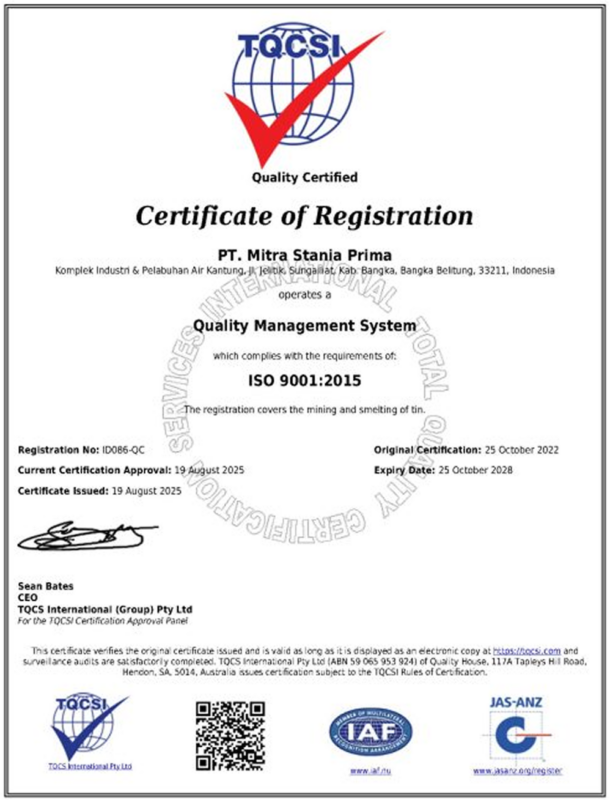
ISO 9001 : 2015 SISTEM MANAJEMEN MUTU
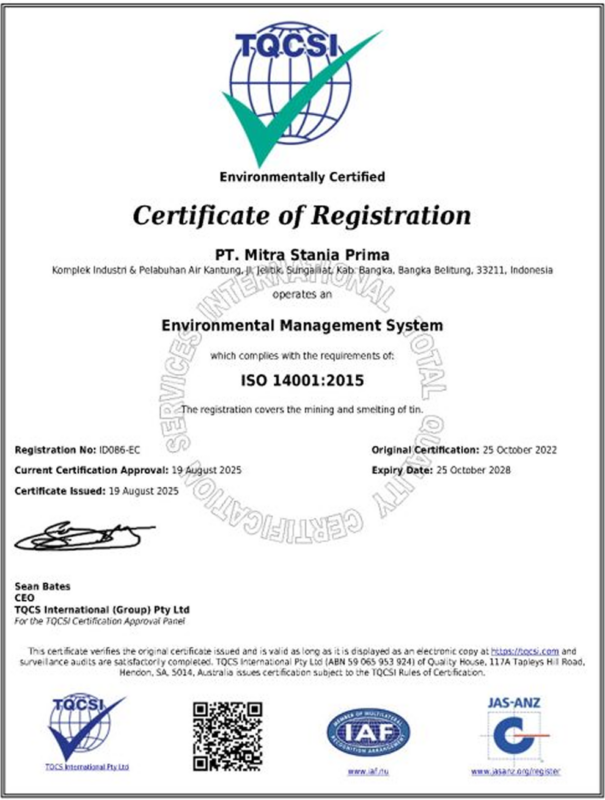
ISO 14001 : 2015 SISTEM MANAJEMEN LINGKUNGAN
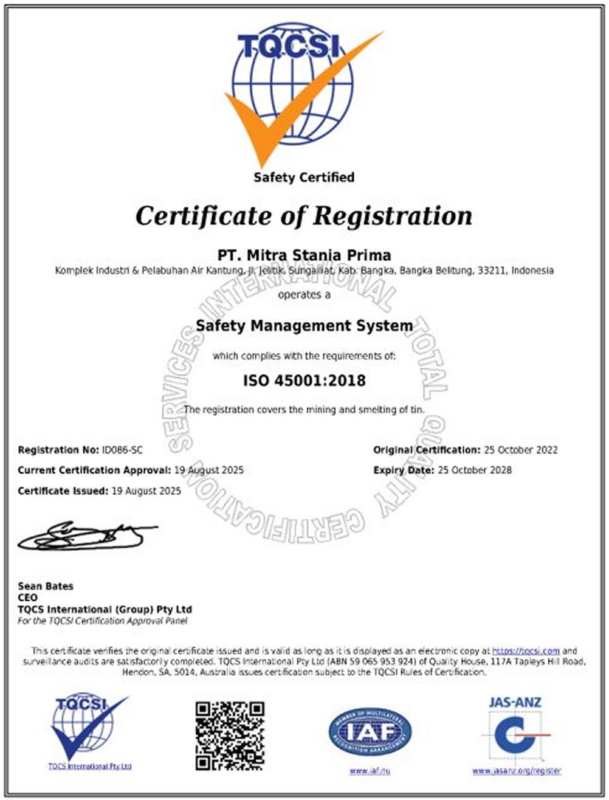
ISO 45001 : 2018 SISTEM PENGELOLAAN KEAMANAN
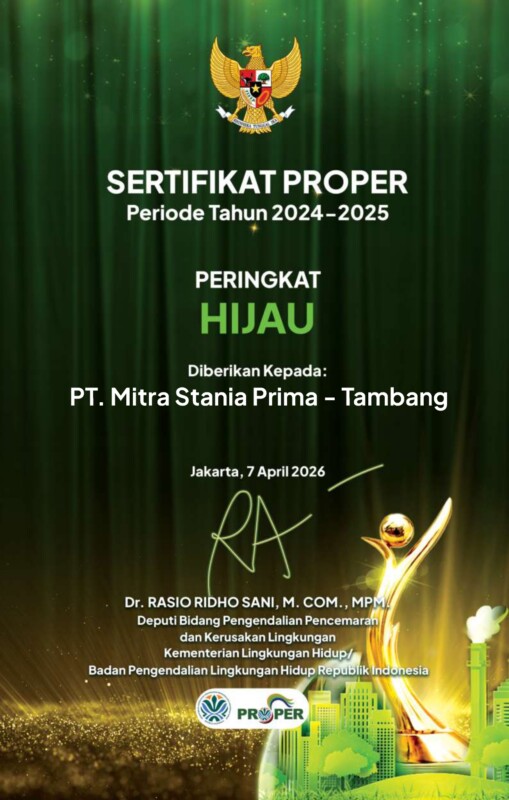
Sertifikat Proper Hijau 2025
untuk site Mapur
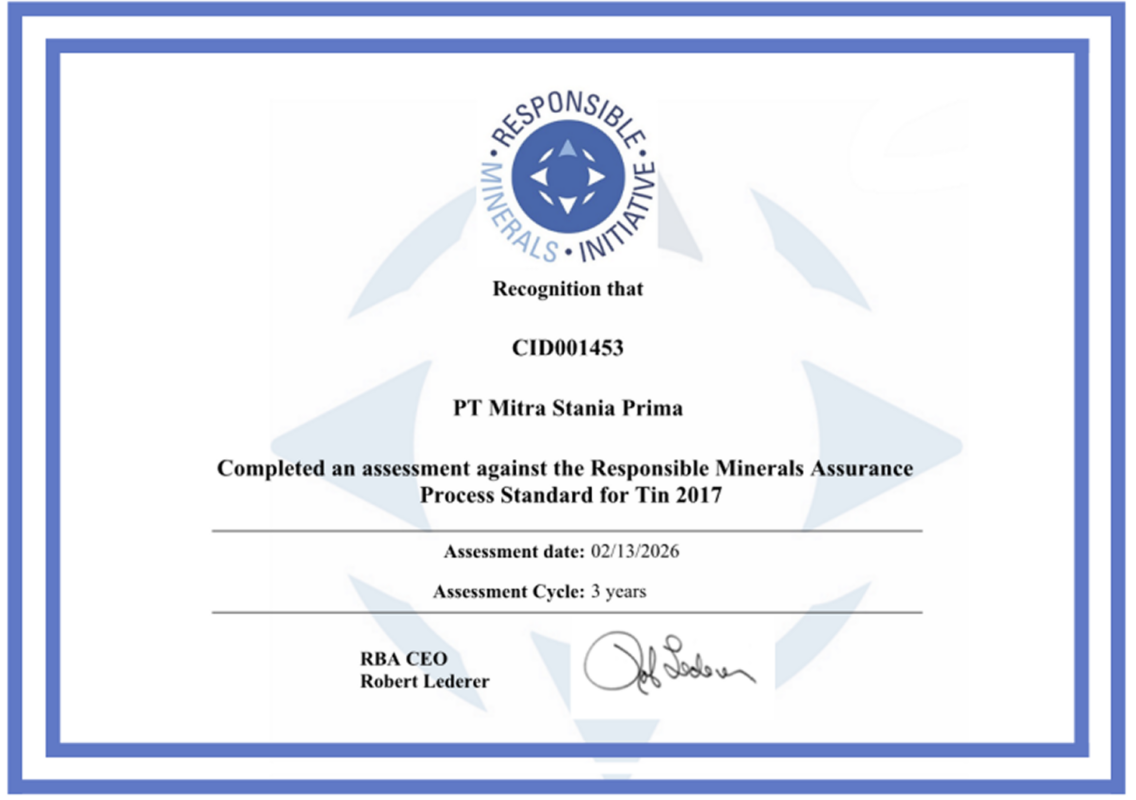
INISIATIF MINERAL YANG BERTANGGUNG JAWAB
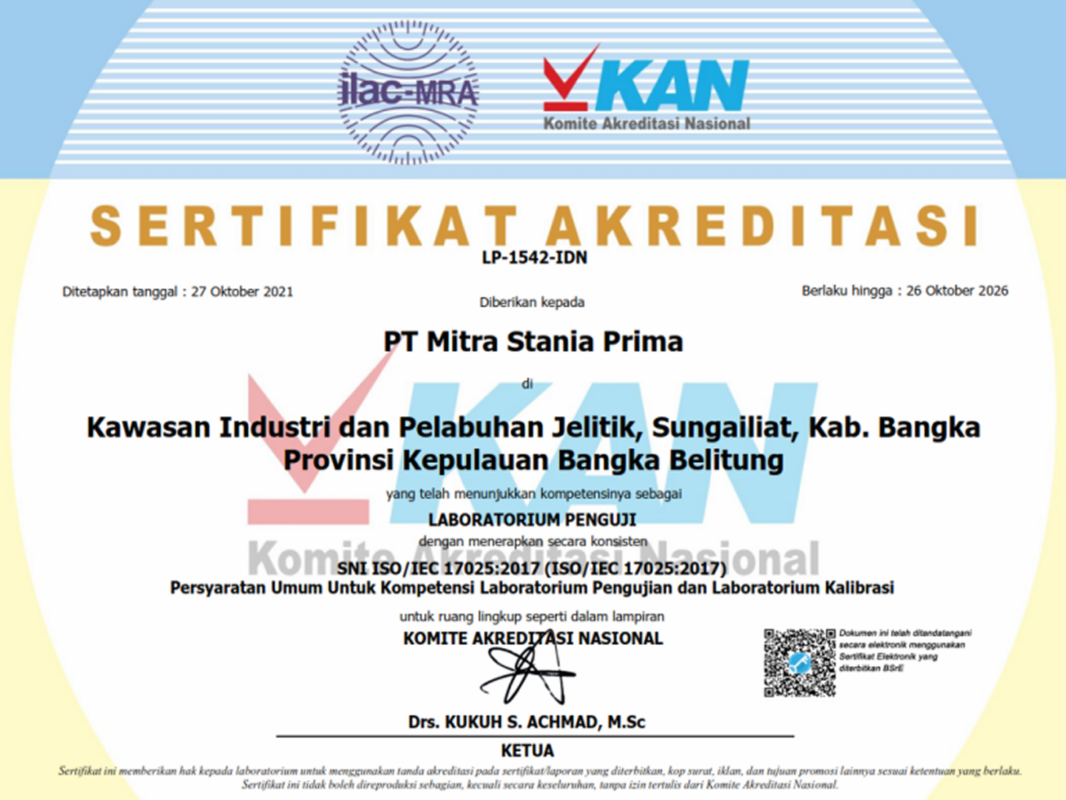
ISO/IEC 17025 : 2017 LABORATORIUM PENGUJI
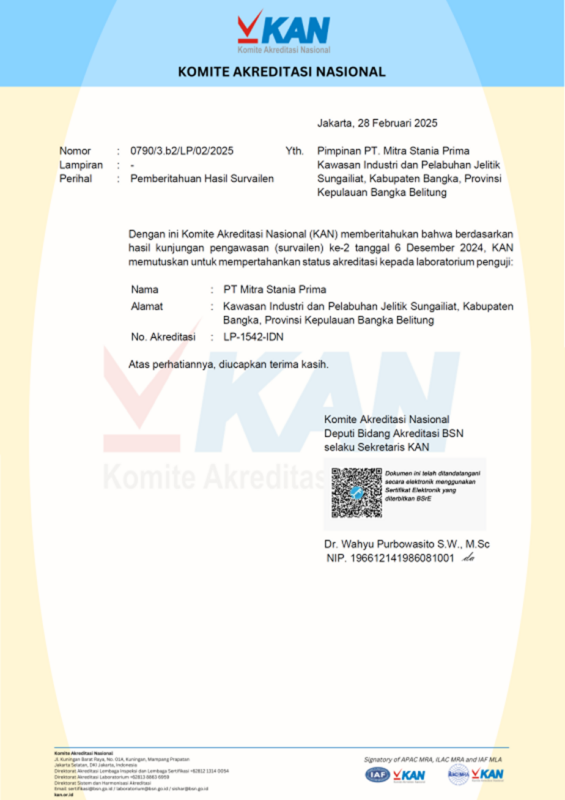
KOMITE AKREDITASI NASIONAL
28 FEBRUARI 2025

Piala Proper Emas 2025
untuk Smelter
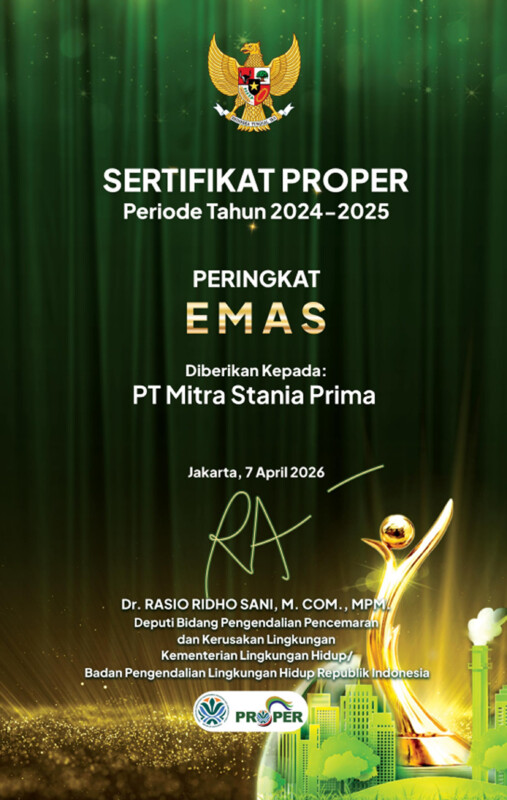
Sertifikat Proper Emas
2025 untuk Smelter

Responsible Mineral Policy
PT Mitra Stania Prima (MSP) is committed to responsible sourcing and production of tin in accordance with the OECD Due Diligence Guidance for Responsible Supply Chains of Minerals from Conflict‑Affected and High‑Risk Areas and the Responsible Minerals Assurance Process (RMAP) 2025 Standard.
MSP solely sources and processes tin ore concentrate (primary material) from mining permit holders (IUP) owned by the company and/or affiliated companies. The company therefore operates an internal upstream mechanism equivalent to RMAP requirements to ensure that all inputs are legitimate, conflict‑free and traceable.
Scope of Policy:
This policy applies to all activities of PT MSP related to procurement, processing, storage, and sale of tin products. It covers due diligence measures across the internal supply chain from the mine to the smelter and extends to cooperation with external warehouses for finished products.
- Compliance with OECD DDG & RMAP Tin Standard
- Internal Primary Sourcing MSP only sources tin ore from its own and affiliated IUPs, excluding third-party, scrap, or recycled materials.
- Protection of Human Rights and rejection of serious abuses (torture, forced or child labour, murder, sexual violence).
- Grievance Mechanism accessible to all stakeholders ([email protected])
- Mass Balance and Traceability system to reconcile inputs, outputs and inventories
- Warehouse Control (Clearance Warehouse) including segregation, labelling, documentation and periodic audits
- Secondary Material Guidance: MSP does not receive or process scrap or recycled tin. The company commits to verify that all materials are primary.
- Internal Upstream Mechanism Equivalency: MSP applies due diligence to its own and affiliated IUPs, including CAHRA screening, KYC, plausibility assessment and internal
- Step 5 Reporting and Continuous Improvement: MSP publishes an annual due diligence report outlining risks identified, mitigation actions and progress.
- Anti‑Corruption and Anti‑Bribery: MSP strictly prohibits bribery, corruption and fraudulent misrepresentation of mineral origin.
- Non‑involvement with Armed Groups and Security Forces Abuses: MSP ensures no payments, services or support are provided to non‑state armed groups or public/private security forces involved in abuses.
- Anti‑Money Laundering and Tax Compliance: MSP complies with all applicable anti‑money‑laundering laws and ensures full payment of taxes, fees and royalties
- MSP maintains a zero-tolerance policy toward any Annex II risks. If such risks are identified, MSP will immediately suspend and terminate all sourcing activities
Continual Improvement
This policy shall be reviewed and calibrated at least once every year as part of PT Mitra Stania Prima’s internal review mechanism, to ensure alignment with due diligence results, the latest RMAP standards, as well as changes in supply chain conditions and national regulations.
Responsible Mineral Policy 2025 document
CAHRA Policies and Procedures of PT. Mitra Stania Prima
CAHRA Policies and Commitments
PT. Mitra Stania Prima (MSP) maintains a Responsible Mineral Supply Chain Policy in alignment with the OECD Due Diligence Guidance and the Responsible Minerals Assurance Process (RMAP) Standard. This policy establishes the company’s commitment to ensuring that all tin mineral sources are derived from conflict-free areas and do not contribute to armed conflict or serious human rights violations. The policy is developed with reference to the OECD Policy Model Annex II and encompasses the consistent implementation of the OECD five step due diligence framework across company operations. The scope of the policy covers all activities from procurement, processing, and storage to the sale of tin products, including the internal supply chain from mine to smelter.
Key commitments under MSP’s CAHRA policy include:
- Compliance with OECD Guidance and RMAP: The company is committed to following the OECD five-step framework and meeting all RMAP requirements, including adopting the definition of Conflict-Affected and High-Risk Areas (CAHRAs) as defined by the OECD. The policy aims to source only conflict-free minerals and ensure proactive and ongoing due diligence.
- Top Management Approval: The policy is signed and endorsed by the President Director and has been effective since 3 December 2025. Top management commitment is demonstrated through the provision of necessary resources and authority for due diligence implementation. The policy is publicly available (https://msptin.com/mining-principle/#supply-chain-policy) and communicated to all suppliers. Compliance requirements are also included in supplier agreements/contracts
- Human Rights Protection and Prohibition of Serious Violations: MSP affirms a zero-tolerance stance toward any form of human rights violations in its supply chain, including strict prohibitions against murder, torture, forced labor, child labor, sexual violence, and other severe abuses. All suppliers are required to respect human rights, and any serious violation will result in termination of the supply relationship.
- No Support to Armed Groups: The policy prohibits any form of support to non-state armed groups or security forces (public or private) involved in violations. MSP ensures that no payments or assistance can fund conflict or armed groups.
- Anti-Corruption, Fraud, and Illicit Financing: The company prohibits bribery, corruption, falsification of mineral origin, and money laundering in operational activities or by business partners. All transactions are subject to transparency checks. MSP mandates full and transparent payment of taxes, royalties, and other official fees to the government, as a commitment to prevent illicit financing and ensure benefits for the state.
- Grievance Mechanism and Transparency: MSP provides a grievance mechanism accessible to employees, suppliers, or other stakeholders ([email protected]) to report suspected policy violations. The company is committed to objectively addressing all complaints while protecting the confidentiality and rights of the complainant. Additionally, the company will publicly report its due diligence performance in accordance with OECD Step 5, including publishing the annual due diligence report on the corporate website.
This CAHRA policy is reviewed periodically, at least annually, to ensure it remains relevant to evolving risks and regulations. Reviews are conducted by senior management responsible for the company’s RMAP compliance. Through the above policy and commitments, MSP affirms its support for ethical mining and mineral trading practices in accordance with international standards, and is prepared for verification through RMAP audits.
CAHRA Policies & Procedures Document
External Grievance and Reporting Mechanisms
A. Scope of Complaints
The report & complaint team will follow up on actions that can harm the company. The scope of complaints includes the following:
- Deviation from the prevailing laws and regulations
- Misuse of position for other interests outside the company
- Extortion
- Cheating
- Conflict of interest
- Customer complaints (either from buyers or from suppliers/vendors)
- Potential risk identified in the company supply chain policy
- Reporters
a. Reporters are required to provide personal data such as name, address, mobile number and email.
b. Include supporting documents for reporting.
c. For violation reporting submitted by stakeholder representatives, other additional documents are required:
1) Proof of identity of stakeholders and stakeholder representatives in the form of photocopies,
2) Power of attorney from stakeholders to stakeholder representatives stating that stakeholders grant authority on behalf of stakeholders,
3. A document attachment states that the party filing the violation report has the right to represent the institution or legal entity if the stakeholder is an institution or legal entity.
d. Written violation reports without an identity may be made, but the reporter must include a copy of the documents related to the report to be submitted. - Reporting Supporting Data
a. The time of the violation, which explains when the violation occurred in the form of day, week, month or year.
b. The location of the violation, including the name of the place where the violation occurred.
c. The parties involved who are responsible for the violation.
d. Whether the violation had occurred before and was reported to other parties. - Submission of Complaints by reporters
a. Reporting must be done in good faith, not for personal or retaliatory purposes.
b. Reporting is made for the common interest of both the company and stakeholders.
The reporter makes a complaint and sends it via:
- Website msptin.com
- Email : [email protected]
- Phone : +62 22 8226 7917
- Form https://docs.google.com/forms/d/1kYKGW_7BMhoGWlyownrGx1-DoLg8qXuu0rTqMLfwQV8/
External Grievance & Reporting Mechanism document
Step 5 Due Diligence Report – PT Mitra Stania Prima (MSP)
Executive Summary
This Step 5 Due Diligence Report summarizes the implementation of PT Mitra Stania Prima’s (MSP) responsible minerals due diligence system in alignment with the OECD Due Diligence Guidance for Responsible Supply Chains of Minerals and the Responsible Minerals Assurance Process (RMAP) Tin Standard. The report covers the 2025 reporting period, with reference to relevant multi-year assessments, and provides an overview of MSP’s policies, governance arrangements, and due diligence practices related to its tin sourcing and processing activities.
MSP operates a closed, internal primary supply chain, sourcing tin ore concentrate exclusively from its own and affiliated mining concessions located in Bangka Belitung Province, Indonesia. In accordance with its documented CAHRA Identification Procedure, MSP applies a structured approach supported by recognized international reference sources to assess conflict and high-risk area indicators. Based on this process, MSP determined that its sourcing locations are classified as Non-Conflict-Affected and Low-Risk Areas (Non-CAHRA) during the reporting period. No indicators of armed conflict or conflict-related human rights risks were identified in relation to MSP’s supply chain.
As part of its upstream due diligence, MSP applies Know Your Supplier (KYS) procedures, risk assessments, and on-the-ground evaluations across all affiliated mining concessions, in line with OECD Step 2 and RMAP upstream requirements. These processes did not identify any OECD Annex II risks, including risks related to conflict financing, serious human rights abuses, corruption, money laundering, or security-related abuses.
At the midstream level, MSP implements traceability, chain of custody, mass balance, and plausibility controls as part of its routine operations. Mass balance reconciliation and plausibility assessments are conducted to support the consistency and reasonableness of material flows within MSP’s internal supply chain. These controls are supported by internal verification and review processes and did not indicate any unexplained discrepancies, material mixing, or unverifiable inputs during the reporting period.MSP also conducted internal reviews and monitoring activities covering key elements of its due diligence system, including CAHRA implementation, traceability and chain of custody, mass balance management, warehouse controls, and documentation practices. No major non-conformities were identified. Minor observations related to documentation consistency and procedural alignment were addressed through corrective actions as part of MSP’s continuous improvement approach.
Transparency and external communication are integral components of MSP’s due diligence framework. MSP publishes its Step 5 Due Diligence Report on an annual basis, and published reports are documented and retained in accordance with internal record-keeping policies. Through these measures, MSP seeks to maintain transparency, support responsible sourcing practices, and ensure ongoing alignment with RMAP requirements.
Overall, this report demonstrates MSP’s continued application of a responsible minerals due diligence system consistent with international expectations. MSP will continue to review and refine its due diligence practices as part of its annual reporting cycle and future assessments.